
How to Recover Lost Organic Traffic After AI Updates (Step-by-Step)
Recover Lost Organic Traffic If your website traffic suddenly dropped after recent Google AI updates, you’re not alone.
Many website owners are confused because:
- Rankings didn’t fall much
- Pages are still indexed
- Content quality hasn’t changed
Yet traffic is clearly down.
The reason is simple: AI search changed how users get answers.
In this guide, Boosters breaks down exactly how to recover lost organic traffic after AI updates, using clear steps that actually work today.
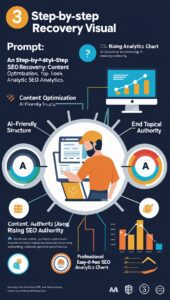
Step 1: Accept the Real Reason Your Traffic Dropped
This is important:
Most traffic losses are not penalties.
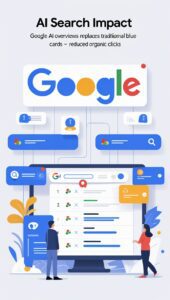
Google’s AI Overviews now:
- Answer questions directly
- Reduce clicks to traditional links
- Push organic results lower on the page
Your content may still be ranking — it’s just being summarized instead of clicked.
Understanding this shift helps you fix the problem instead of guessing.
Step 2: Optimize for AI Visibility, Not Just Rankings
Old SEO focused on “rank #1.”
New SEO focuses on being selected by AI.
To recover organic traffic:
- Answer the main question in the first 2–3 lines
- Use short paragraphs
- Add bullet points and steps
- Avoid unnecessary filler
AI prefers content that is clear, direct, and easy to extract.
That’s how you regain visibility.
Step 3: Improve Content Structure (This Matters More Than Keywords)
Even great content can fail if it’s hard to scan.
Fix this by:
- Using proper H2 and H3 headings
- Breaking long paragraphs into short ones
- Adding lists, summaries, and FAQs
Well-structured content helps:
✔ AI understand your page
✔ Users stay longer
✔ Rankings stabilize faster
Structure is no longer optional — it’s essential.
Step 4: Build Topical Authority, Not Random Blog Posts
One-off articles don’t work anymore.
To recover lost organic traffic after AI updates, Google wants to see topic depth.
That means:
- Writing multiple articles around one main topic
- Linking them together internally
- Covering beginner to advanced angles
At Boosters, we use this approach across all our SEO services to rebuild traffic sustainably:
👉 https://boostersmarketingagency.com/product-category/services/
You can also explore more strategies in our blog section:
👉 https://boostersmarketingagency.com/blog/
Topical authority is one of the strongest ranking signals in AI search.
Step 5: Refresh Old Content Instead of Publishing New Posts
One of the fastest wins is updating existing content.
AI prefers content that is:
- Fresh
- Accurate
- Recently improved
Update posts by:
- Adding new examples
- Improving clarity
- Updating dates and statistics
- Strengthening internal links
Refreshing old pages often restores traffic faster than publishing new ones.
Step 6: Match Content With Search Intent (AI Is Very Strict)
AI understands user intent better than ever.
Make sure your content matches what users want:
- Informational → clear explanations
- How-to → step-by-step guidance
- Commercial → comparisons and benefits
- Transactional → services and solutions
If intent doesn’t match, AI ignores your page — even if it’s well written.
Step 7: Strengthen Brand & Trust Signals (EEAT)
AI search doesn’t just rank pages — it evaluates brands.
Improve trust by:
- Showing real expertise
- Publishing consistently
- Maintaining an active social presence
Connect your website with your social platforms:
- 👉 Facebook: https://www.facebook.com/boosterofficials
- 👉 Instagram: https://www.instagram.com/boostersofficials/
These signals help Google trust your brand and feature your content more often.
Step 8: Learn From Websites That Adapted Well
Some websites adapted smoothly to AI search because of clarity and structure.
Good examples:
- Fashionholic uses clean layouts and simple product descriptions:
👉 https://fashionholic.pk/ - Organic Herb Store benefits from organized categories and user-friendly content:
👉 https://organicherbstore.com/product-category/products/
Their success shows that simple, helpful content wins in AI search.
Step 9: Track the Right Metrics (Not Just Traffic)
After AI updates, traffic alone doesn’t tell the full story.
Track:
- Impressions
- Visibility
- Brand searches
- Engagement
Even if clicks drop, brand exposure often increases — leading to:
✔ Direct visits
✔ Returning users
✔ Higher trust
This is how organic growth works now.
Step 10: Stay Consistent — Recovery Takes Strategy
AI updates don’t reward panic.
Avoid:
❌ Deleting content randomly
❌ Keyword stuffing
❌ Publishing low-quality posts
Instead:
✔ Improve structure
✔ Update content regularly
✔ Build topical authority
✔ Focus on real users
This is how websites recover — and grow — long term.
Final Thoughts from Boosters
If your organic traffic dropped after AI updates, SEO isn’t broken — it evolved.
Websites that adapt by:
- Writing clearer content
- Structuring pages better
- Building authority
- Strengthening trust
…don’t just recover traffic — they future-proof their growth.
That’s the SEO approach we follow at Boosters, and it’s what works today.



Leave a Reply